
Getting the Most Out of Your Fragrances
Go behind the scenes with Stock Fragrance co-founder Nathan Motylinski as he walks Marie Rayma of Humblebee & Me through the science, trade-offs, and secrets of the professional fragrance industry.
Watch the full conversation on YouTube. Hosted by Marie Rayma of Humblebee & Me with Stock Fragrance co-founder Nathan Motylinski.
1,000+
Materials in
Cécile's palette
Cécile's palette
140°F
Minimum flashpoint
for Stock Fragrance oils
for Stock Fragrance oils
1970s
When natural animal
extracts were banned
extracts were banned
Reference
Speaking Fragrance: A Quick Glossary
Terms that come up in the conversation, defined plainly.
- Flashpoint
- The temperature at which a fragrance's vapors can ignite. Lower flashpoints mean more volatile materials and trickier shipping and handling. Stock Fragrance sets a 140°F minimum across our oils.
- Headspace
- The air above the oil in its container. The more headspace relative to the oil, the faster it oxidizes. Transferring oils to smaller bottles as you use them slows the clock.
- Shelf Life
- How long a fragrance oil stays close to its original profile. Officially 12 months from production; with good storage, multiple years.
- Dosage
- The percentage of fragrance oil in a finished product. Face and body products typically 0.5%–2.0%; candles 6.0%–12.0%; fine fragrance 15.0%–35+%. Our fragrance oil calculator handles the math for determining fragrance oil needs.
- Maceration
- The resting period after a fragrance is blended into a product, during which the oil integrates with the base on a molecular level. Typically 1–2 weeks for a finished product such as personal care or candles. Our own oils macerate for several days before they leave production.
- Bloom
- How a fragrance behaves when activated by water or heat — the moment in the shower with a body wash, or when a candle's wax pool melts. Different from the bottle impression, and a key part of functional fragrance development.
- Microencapsulation
- Embedding fragrance in tiny friction-breakable bubbles so it survives harsh environments such as wash and dryer cycles. This is how some laundry detergents "stay" on fabric for weeks. View our encapsulation services.
- Substantivity
- A fragrance's ability to remain on a substrate (fabric, hair, skin) after the product is rinsed or removed.
- SDS
- Safety Data Sheet. The standard document used for fragrance oil handling, transport and storage. How to read an SDS.
- IFRA
- The International Fragrance Association. Sets safety and usage limits for every fragrance material by application category (face, body, candle, laundry, etc.) based on skin exposure and the total allergen levels in a fragrance formula. While IFRA compliance is voluntary, most professional formulators consider compliance non-negotiable. Learn more.


Behind the scenes in the compounding lab.
The Interview
The Full Transcript
Below is the conversation in full, lightly edited from the captions for readability. Section headings reflect the actual questions Marie asked.
Meet Stock Fragrance
Marie: Hello and thank you so much for tuning in, and a big thank you to Nathan for being here. So I'm really excited about this presentation because we're going to be talking about how to get the most out of one of the most expensive and important ingredients in your formulations, which is your fragrances. Scent is of course very personal and a huge part of how we experience our products. I know whenever I gift somebody anything I've made, the very first thing they do is smell it. Now if you have ever experienced the scent of your products fading or changing over time, you'll know how frustrating that is — especially if you're selling them. So today we're going to be talking about some of the reasons that can happen and tips and strategies to stop that from happening so you can get the most out of your fragrances. Most of what we're going to be talking about today is going to be fragrance oil specific, but there's a lot of overlap for working with essential oils as well.
Marie: Hello, I'm Marie. I run Humblebee & Me and I have been formulating for over a dozen years. My guest today is Nathan, who is one half of the husband-wife team behind Stock Fragrance. I met Nathan back in 2023 at the Handcrafted Soap and Cosmetic Guild annual conference in Kansas City, where I was able to smell all of their beautiful fragrances and was very quickly smitten with them. The reason I reached out to Nathan and Stock Fragrance in particular about this interview is because Stock Fragrance actually designs and makes their own fragrances. Most of the suppliers that I shop from order their fragrances from fragrance houses — companies that specialize in fragrance. So it's sort of like a grocery store ordering in produce from a farmer. Stock Fragrance is like the farmer. They're actually really the ones pulling those carrots out of the ground. So whenever I have a really nerdy question about fragrance, they're who I ask.
“
I met Cécile, and her fragrances were so good that I fell in love with her.

Nathan: My name is Nathan. My wife and I founded Stock Fragrance a couple years ago. Backstory on us is we both come from the professional fragrance industry. My wife Cécile is Vice President of Creative and Technical Perfumery at a company called Mane, which is one of the largest fragrance houses in the world. They're a top-five global, largest in France, and they're actually the only family-owned fragrance house left at that level. I came into the fragrance business really from the brand side — that's actually how I met Cécile, and her fragrances were so good that I fell in love with her, and now we have four kids and a business together and here we are.
Nathan: I've done fragrance and product development for a range of different types of companies. I started out in the niche air care and candle space and eventually ended up helping larger consumer goods companies with their offerings — Seventh Generation, Grove Collaborative, a bunch of larger companies. Our core business is really custom development. We started Stock Fragrance during COVID, mainly because we had a lot of new business requests from smaller companies and startups, and we honestly were turning away a lot of business. One of the questions I got a lot was, "Well, if I don't do custom development, where can I go for fragrance oil?" Cécile and I were kind of scratching our head on where to point people to go, and we said, maybe we should put some oils out.
What Do Top, Mid & Base Notes Actually Mean?
Marie: Could you talk a bit about the structure of a fragrance? I think most people who formulate are probably familiar with the general idea of a top note and a base note, but can you chat a little bit more about those and how they're balanced?
Nathan: In the traditional sense there's the fragrance pyramid of top, mid, and base (or dry) notes. Usually that's just speaking to how quickly those notes flash off — meaning disperse into the air. Not all materials have the same flash points or VOCs. The point of all fragrances is to try and get into the air, and some materials can do that much quicker than others. An example of a top note would be citrus — something you smell initially. If you're thinking about perfume, top notes are everything you smell when you spray the first spray — you get this huge impression. Then within the next hour the fragrance changes, closes in a little, and you're left with the more mid to bottom notes. Bottom notes are what you're left with over an extended period or on your clothes the next day.
Stage 01
Top Notes
First spray → first hour
The first impression — bright and volatile. Citrus is the classic example, and it flashes off fastest.
→
Stage 02
Heart / Mid
As it settles → 2–6 hours
What emerges within the hour as the fragrance closes in and the top notes fade.
→
Stage 03
Base / Dry
Lasting impression → 6+ hours
What's left over an extended period — still on your clothes the next day.
How a fragrance moves through top, heart, and base notes over time.
How Is Fine Fragrance Different From Functional Fragrance?
Nathan: That pyramid is really specific to fine fragrance or perfume. If we think about using a body lotion, you're not going through the same experience. With a body lotion you have out-of-bottle impression, in-use impression, and then over time — so you lose a lot of those top notes. Or if you look at a shower gel, part of the development process is what we call bloom. Bloom is what happens in the shower when you use it. Over the years when Cécile's been doing development, she brings home samples and we evaluate at home — how is the shampoo, can you smell it from outside the shower, how long does your bathroom smell like that?
Marie: That makes sense. With a lotion your experience is going to be different because it stays on your skin — can I still smell this on my hand two hours after I applied it? Versus a shower gel, your primary experience is for call it the three minutes you're using it, plus any smell that lingers in the bathroom. You're not expecting it to linger on your skin the way you might expect a lotion or a perfume to. It's a different evaluation of what success looks like.
What's Actually In A Fragrance Oil?
Marie: So when we're talking about fragrances, what is in it? What are some examples of the component ingredients — especially the weirder ones?
Nathan: Cécile's palette currently is over a thousand materials, some natural and plant-based, some not. There's a ton of stuff that you and I have never heard of that gets used for various reasons — on their own they'd mean nothing, but combined with whatever else is happening in the formula they become an important part of the fragrance.
Nathan: When we look at plant-based formulations there's more than just essential oils. We have access to other isolates that are still plant-based but not available on a consumer level. When you look at sustainability, the default tends to be towards essential oils — but harvesting plants can be very hard on the environment and on people. When you take a more holistic approach, there's a lot of reasons to look at other sources too.
What Is Ambergris, And Why Is Musk Synthetic?
Nathan: There is currently no natural musk available in the fragrance industry because of animal cruelty rules — it hasn't been available for a number of decades. So basically every musk that exists in fragrance is synthetic.
Marie: Could you tell us what musk is originally?
Nathan: Typically musk is extracted from beaver glands. It's a rather undistinguished part of the animal. Even if it was extracted in a humane way, the perfume industry does not allow any extraction from animals — period, humane or not. And if you smell musk on its own, it's a borderline offensive smell. It's not something you'd say, "I want to rub this over me." But once it's in a fragrance, Cécile uses it to boost or prop up other parts of the fragrance. It's not a highlight per se — it does things to highlight other ingredients.
Marie: So maybe a little like salt — if you ate a teaspoon you'd be like, "Oh, gross," but food isn't its best self without some salt.

Nathan: Exactly. Another ingredient that's allowed: it does come from an animal but is not extracted from the animal. This is ambergris. If you look at this — it's actually a squid beak. It comes from a whale that ate the squid. The squid gets embedded in the digestive system, the beak can't be digested, and a coating gets created to cover the obstruction. Eventually these pieces float in the ocean, and you can harvest them directly. If I had to describe how it smells, it's almost on the borderline of woody mothballs — a very rich and funky smell.
Nathan: At Cécile's company they have a proprietary machine called the Jungle Extractor. It uses CO₂, so there's no temperature change during extraction — temperature change can already change the olfactive character of, for example, jasmine. They've extracted from a sailboat that was in a regatta to get the smell of the ocean. Cécile took it to Cuba — they have a specific type of juniper that's going extinct, so they wanted to recreate the smell. They put the machine on the plant, extracting the headspace, then take it to GC or do organoleptic evaluation — smelling with your nose. Usually a mix of both. Here's a case where science is helping nature — instead of harvesting the wood, you're able to recreate it with materials you have, and it's much more sustainable.
How Do You Spot A Quality Fragrance Oil Online?
Marie: A real challenge is that most of us are ordering ingredients online. There's not a lot of brick-and-mortar shops. You're reading descriptions, maybe getting recommendations, but you can't smell it before you buy. How do you evaluate quality?
Nathan: All fragrance smells good — nobody's really making anything that smells bad. So the question becomes how to know if it's quality. One place you can look technically is an SDS document. If you have an SDS that's very vague, that's a watch-out. If flash points look out of whack — over 200, over 300, or really low room-temperature flash points — that can be an indicator. For our fragrances we set a minimum 140°F flashpoint.
"If you have an SDS that's very vague, that's a watch-out."
Nathan: The biggest indicator for a general consumer: on most safety data sheets they'll list ingredients and components. If you see one or two ingredients constituting over 50% of the formula, that's probably carrier or solvent. If it's got 60% benzyl benzoate — that's a solvent used to enhance candle performance, and it works, but it's a very inexpensive material. There's not much room left for the potent fragrance ingredients.
Nathan: If we think about quality, three aspects: quality of the materials, quality of the construction, and how much of those materials are in the fragrance. The more actives, the more concentrated. When you're working with a perfume dosed at 30%, you have a lot more fragrance than a face cream dosed at 0.6 or 0.4. This is where you see the difference in performance — for your fragrance to work at low dosage, it needs to be concentrated.
Why Does Fragrance Documentation Matter?
Marie: Before we knew each other, I would start by making sure I was shopping from a company I trusted. Checking documentation. The more docs, the more ticks in the pros column. If it was a dupe of a scent I already knew, I'd feel confident I knew what it would smell like.
Nathan: Knowing where the quality is has to do with trust, and the only way to build trust in this setting is transparency — paperwork and what you're willing to disclose. That doesn't mean giving somebody the formula, but I'll tell you what you need to know. If you came to me and said, "I'm allergic to tree nuts, is there any tree nut derivatives?" I can check. That's what builds the trust factor. If you're not making your own stuff, you can't answer that — you'd be like, "I got it in this jar from company ABC, I hope they know what they're doing."
How Should You Store Fragrance Oils, And How Long Do They Last?
Nathan: Three things prolong your fragrance oil: temperature control (50–80°F, avoid swings), UV protection (we use aluminum bottles), and minimizing headspace. The 55-gallon drum example: if you keep 10 gallons in a 55-gallon drum, it oxidizes much quicker because of all the air. Same as wine.
Pro tips for extending fragrance oil shelf life
01
Control Temperature
Keep oils between 50–80°F and avoid big temperature swings, so a temperature controlled environment is ideal.
02
Block UV Light
Store in opaque containers and out of direct sun and fluorescent light.
03
Minimize Headspace
Transfer oils into the smallest container that fits. Less air means slower oxidation — like wine in a near-empty bottle.
Marie: What do you mean by "a long time"? I just did a studio clean and found oils from 2013.
Nathan: That's a really long time. I would not use that. Our official paperwork is 12 months from production. Could be extended to several years if stored well. We usually purge after two years — even development samples — because at that point you start to drift from the original. All fragrance oxidizes over time. Fresh is always better — you can't go wrong with that.
"Official shelf life is 12 months from production but oils can typically last much longer."
When Should You Add Fragrance To A Formula?
Marie: Usually with a fragrance, if the product has to be heated, I'd add it in the cool-down phase at below 50°C. But sometimes you can't — solid balm with beeswax, below 50°C is solid. Then I add as late as I can and cool the product as quickly as possible.
Nathan: That makes total sense. The first product that comes to mind is candle — you can't pour candle unless the wax is melted. You want to minimize that, but the fragrance will survive. If you're exposing it to extreme heat like a dryer, that gets a lot more challenging, and we have to go to other processes.
How Do Big Brands Make Laundry & Shampoo Scent Stay?
Nathan: Products like laundry detergent require help in the form of microencapsulation — protecting the fragrance in a tiny bubble that doesn't break until you want it to. Those bubbles help the fragrance survive wash and dry cycles, even for shampoo. As you blow-dry, all the fragrance comes off — but if you embed it in microcapsules, the capsules are friction-based and break on contact. That's how you get two weeks of scent on fabric, or "I move my hair and it smells stronger."
Marie: So that's another industry thing small makers don't have access to. You can't just buy a bottle of "encapsulated fragrance oil."
Nathan: Correct — it's a special process. You have the fragrance oil, the oil gets encapsulated, then you can remix it back into fragrance oil. There's a component of embedded so some you encounter first, plus some that's insulated to last longer. The process adds a whole new set of requirements — flash point, boiling point, water solubility — and ingredients that can't meet those get lost. There's one plant-based essential oil that lasts out of the dryer: patchouli. Whether you like it is up to you. Most people, not a fan.
How Much Fragrance Should You Actually Use?
Nathan: Strength isn't objective — it comes down to whoever's making the decision. In our experience, for face and cosmetic and beauty you won't see anything over 2%. Body, same. Perfumes could be up to 30, 35%. Beyond that — do you really need that? It's not just dosage driving portrayal, it's the fragrance itself. We could make two completely different style fragrances and one would smell a lot bigger than the other.
Typical Dosage by Application
| Application | Typical Dosage |
|---|---|
| Face Cream | Under 1.0% — less is more! Proximity to the nose means a little goes a long way. |
| Face & Body Cosmetics | 1.0%–2.0%. Most beauty and personal care product bases have trouble holding more than this. |
| Candle | 6.0%–12.0%. IFRA limits are skin-based, so candles allow more — though sometimes less gives better hot throw. |
| Fine Fragrance | 15.0%–35.0+% — depends on desired performance and classification (eau de toilette, eau de parfum, eau de cologne, eau fraiche, etc.). |
Marie: If you had a fragrance heavy on volatile top notes, and another more evenly blended through top, mid, and base — you could use the top-note-heavy one at 30% and the blended one at 15% and get a stronger, longer-lasting experience from the 15% version. That's about the characteristics of the blend, not the usage level.
Nathan: Exactly. When we do development we fix a dosage at the start — everything at the same dosage so we can smell them in a row. Then if you create a collection, you might dose one at 22%, another at 20, so consumers don't say, "This one smells way stronger than this one." Different characters, you play around with it.
Marie: So this is another way big companies have access to strategies smaller makers don't. If you go to Bath & Body Works and they've got a line — an EDP, a body butter, a body wash, a foaming hand wash — even though your experience is consistent, the fragrance is probably lightly reformulated for each application. As a smaller maker using the same fragrance oil in a lotion, soap, shampoo bar, and body butter, if you're not getting that uniform experience: that's why.
How Long Does Fragrance Need To Develop In A Product?
Nathan: Fragrance going into a product is like soup — it needs time to integrate. Give it a week or two and it'll smell more than when you mix something in a lab and start smelling right away. That's true for the oil itself too. Even in custom development, we don't make oil and send it out the same day. Production has to mature for several days. You can't rush the science and chemistry.
"Even in custom development, we don't make oil and send it out the same day."
Marie: So I should have an opinion as soon as I incorporate it in the cool-down phase, but not judge it completely on that.
Nathan: Exactly. Generally one-to-two-week range — that's when you see the fragrance fully in the product. Both stronger and fuller. Better integrated on a microscopic level. The fragrance is trying to get out of the product — if it can't get into the air, it's not working. As it sits in the base, it integrates and finds ways to escape, and that's what it does best.
Marie: A couple places that doesn't line up: cold-processed soap, shampoo bars — products you leave out to age. The water content needs to evaporate.
Nathan: There's only so much you can do. Same for candles when they're curing. If you sell a candle with a lid it has much better cold throw than one that doesn't, because the one without is constantly evaporating.
Can You Cover Up A Strong-Smelling Base Like Shea Butter?
Marie: If you have a whipped shea butter with 60% raw shea, it's going to smell like shea butter. The question I'm asked most: how do I cover up the smell of shea butter? My answer is always, you can't. Like lavender-scented dog poop bags — it just smells like dog poop and lavender.
Nathan: That holds true everywhere. You can fight it or go with it — depends on the base. Almost all bases have an odor, even unscented laundry detergent. Most of the time you're overcoming that with the fragrance. Even your standard store-bought laundry detergent is relying on the fragrance to cover base odor — not working with it, covering it up. In some cases you can't cover, and you have to work with it. That's the delicate balancing act of creative and technical perfumery.
Nathan: Another thing we can do (less applicable to face creams) — apply malodor counteractants. Materials that block your receptiveness to certain smells. They identify the molecules that make up bad smells. It's less than you think. We've done formulation work with that and they work.
Why Does Product Scent Fade, And How Do You Prevent It?
Nathan: We all desensitize to fragrance. The more you smell something, the less you can smell it. If you wear perfume by the end of the day you don't notice it — everybody else still does. Nose fatigue is real. In general, you shouldn't see a lot of diminishment in any product that's closed. As long as it's enclosed in packaging, it shouldn't lose much. If it's not enclosed, it's going to lose fragrance no matter what.
Marie: Strategies to help prevent scent fading, beyond not damaging during making and reducing air exposure: including a chelator can extend life. And if you can get it, use PPG methyl glucose ether — INCI name — sold as Aroma Fix by Lotioncrafter. It's a humectant that acts as a fragrance fixative by subduing the evaporation of those high notes.
Give it time.
Start with small batches.
Take more notes than you think you need.
Experiment.
Marie: Thank you so much, Nathan, for being here today. I learned so much and honestly feel a little bit vindicated knowing that there are some technologies out there that we just don't have access to.
Nathan: There's a lot out there. Do not expect to mix a few essential oils and get the same type of performance — or even fragrances you might smell in other products.
Marie: It is a science, it is an art, there's a lot of technology there.
It was never going to be as simple as "just add 1% fragrance and you're off to the races" with anything this complex and with such a long history of expertise.
Quick Answers
Frequently Asked Questions
Quick answers pulled from the conversation. Open any question for the relevant verbatim exchange.
How do I know if a fragrance oil is high quality?+
Check the SDS. If one ingredient makes up more than 50% of the formula, it's probably a carrier or solvent like benzyl benzoate, which dilutes performance. Concentrated oils outperform diluted ones at lower doses.
Nathan: All fragrance smells good — nobody's really making anything that smells bad. So the question becomes how you know if it's quality. One of the places you can look technically is an SDS document. If you have an SDS where flash points look really out of whack, or where one or two ingredients constitute over 50% of the formula, that's probably either carrier or solvent. If you see 60% benzyl benzoate, that's a very inexpensive material — and there's not a lot of room left for the more potent fragrance ingredients.
How long do fragrance oils last?+
Official shelf life is 12 months from production. With proper storage they remain usable for several years. Stock Fragrance purges its own oils at the two-year mark to stay close to the original profile.
Nathan: On our official paperwork it's 12 months from production. That could likely be extended to several years if stored well. For us, we usually purge after two years — even development samples — because at that point you really start to drift from what the original oil was. All fragrance oxidizes over time. In product, not in product — it doesn't matter. It's an evolving thing. Fresh is always better, but if it sits for a while it's going to be okay.
How should I store my fragrance oils?+
Temperature-controlled (50–80°F, no large swings), out of UV light, with minimal air headspace. The smaller the container relative to the amount of oil, the slower it oxidizes.
Nathan: In short, you want your fragrances in a temperature-controlled environment. It does not need to be 72 degrees year round — you need to avoid temperature swings. You don't want it to change temperature by 40° back and forth. As long as you're in the 50–80°F range, that's stable enough. You also want to avoid exposure to UV light. And minimize the amount of headspace — the surface area of air the actual oil is exposed to. If we send you a 55-gallon drum and you've got 10 gallons left, it's going to oxidize a lot quicker because there's 45 gallons of air in there. Same as wine — one glass left in the bottle oxidizes much faster than a full bottle.
How much fragrance oil should I use in a product?+
Face and body cosmetics: rarely above 2%. Fine fragrance (perfume): up to 30–35% maximum. Beyond those levels, additional dose stops improving the experience — the character of the blend matters more.
Nathan: Strength isn't objective — it comes down to whoever's making the decision. But in our experience, for face and cosmetic and beauty you're not going to really see anything over 2%. Body, same. Perfumes could be up to 30, 35%. If you get over that it starts to become, "Do you really need that?" — because if a client says "I want this dosage in perfume," it's not just dosage driving the portrayal, it's the fragrance itself. We could make two completely different style fragrances and one would smell a lot bigger than the other one just based on what they are.
When should I add fragrance to my formula?+
In the cool-down phase, below 50°C / 122°F whenever the base allows. When the base requires heat (candles, solid balms), add as late as possible and cool the product quickly to minimize heat exposure.
Marie: Usually with a fragrance, if the product has to be heated, I would be adding that in the cool-down phase at like below 50°C. But sometimes you have situations where that's just not possible — you're making a solid balm with a bunch of beeswax in it, below 50°C is solid. In a situation like that I'm trying to add it as late as I can and then get the product to cool as quickly as possible.
Nathan: That makes total sense. The first product that comes to mind is candle — you can't pour candle unless the wax is melted. Wax melt points usually 40 degrees and up. You want to minimize that, but the fragrance will survive.
Why does my product's scent fade over time?+
Two causes: air-driven oxidation, and nose fatigue. To slow oxidation, include a chelator and a fragrance fixative like Aroma Fix by Lotioncrafter (INCI: PPG methyl glucose ether). If the product is in closed packaging, true fade should be minimal — the rest is your nose desensitizing.
Nathan: We all desensitize to fragrance. The more you smell something, the less you can smell it. If you wear perfume by the end of the day you don't even notice it — everybody else still does. You can have nose fatigue. But in general, you shouldn't see a lot of diminishment of the fragrance in any product that's closed. As long as it's enclosed in some sort of packaging, it shouldn't be losing much. If it's not, it's going to lose fragrance no matter what.
Marie: From a formulation point of view — including a chelator can help extend the life of your fragrances. And if you can get it, you can also use an ingredient with the INCI PPG methyl glucose ether (quite the mouthful), sold as Aroma Fix by Lotioncrafter. This is a humectant that acts as a fragrance fixative by subduing the evaporation of those high notes so they don't dissipate as quickly.
What's the difference between fine and functional fragrance?+
Fine fragrance is the product itself — perfume, cologne, EDP. You experience it walking through top, mid, and base notes over hours. Functional fragrance lives inside another product (lotion, shower gel, candle) and is judged on in-use impression: bloom in the shower, hot throw in a candle, fabric lingering.
Nathan: The fragrance pyramid of top, mid, and base is really specific to fine fragrance or perfume. If you use a body lotion, you're not going through the same experience. With a shower gel, part of the development process is what we call bloom — what happens in the shower when you use it. With a shampoo: can you smell it from outside the shower, and how long does your bathroom smell like that?
Shop
Explore Our Fragrance Oils
Related Reading
Leave a comment
Comments will be approved before showing up.
Also in Fragrant Thoughts


Live Smelling Session: Raleigh, NC
Our first live fragrance smelling session in Raleigh, NC. We explored five rose raw materials — from $5/kg synthetics to $25,500/kg May Rose Essential Oil — then smelled five fragrance oils across candles, lotions, solid perfume, and eau de toilette.

The Science of Clean Fragrance
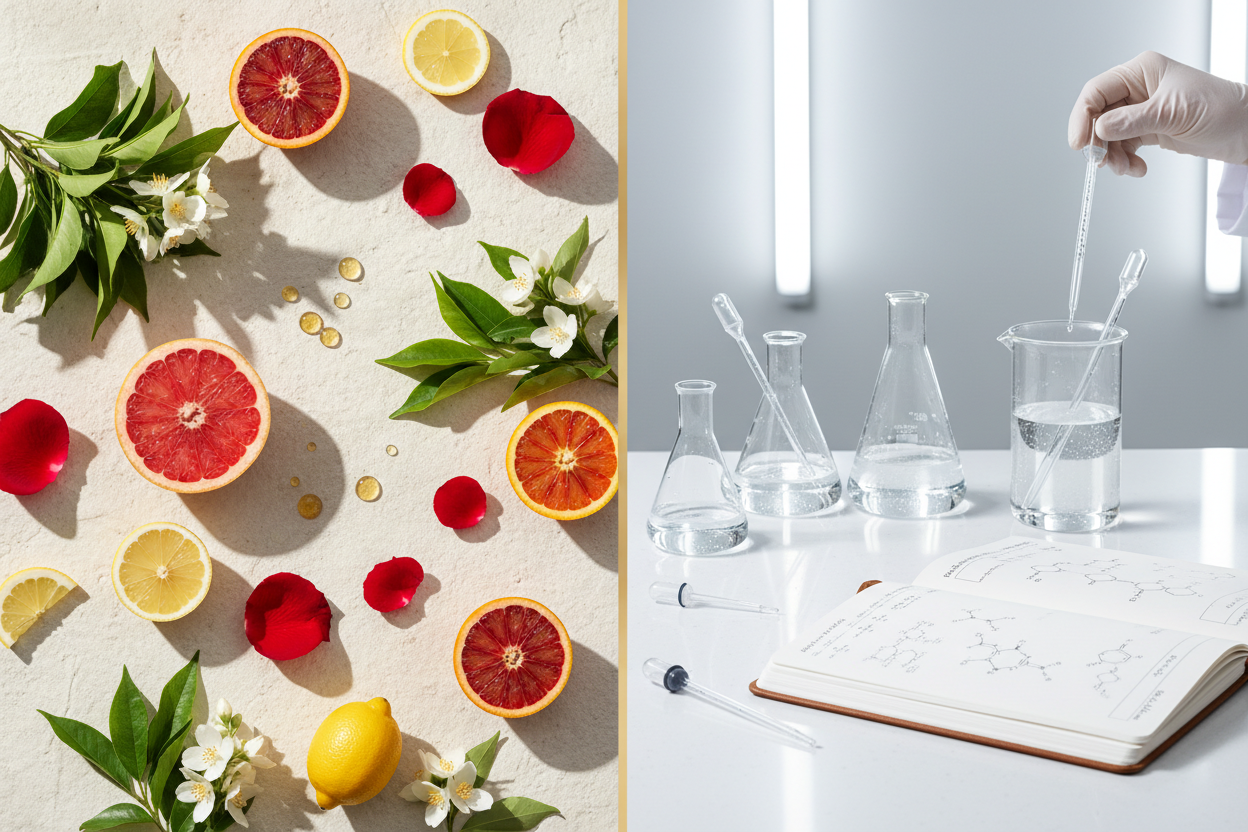
“Clean fragrance” is everywhere—but rarely defined. This science-based guide explains what clean fragrance actually means, how safety is determined, why natural doesn’t always equal safer, and how IFRA, ISO, EWG, and retailer standards shape modern fragrance formulation.

Fragrance Strength & Longevity
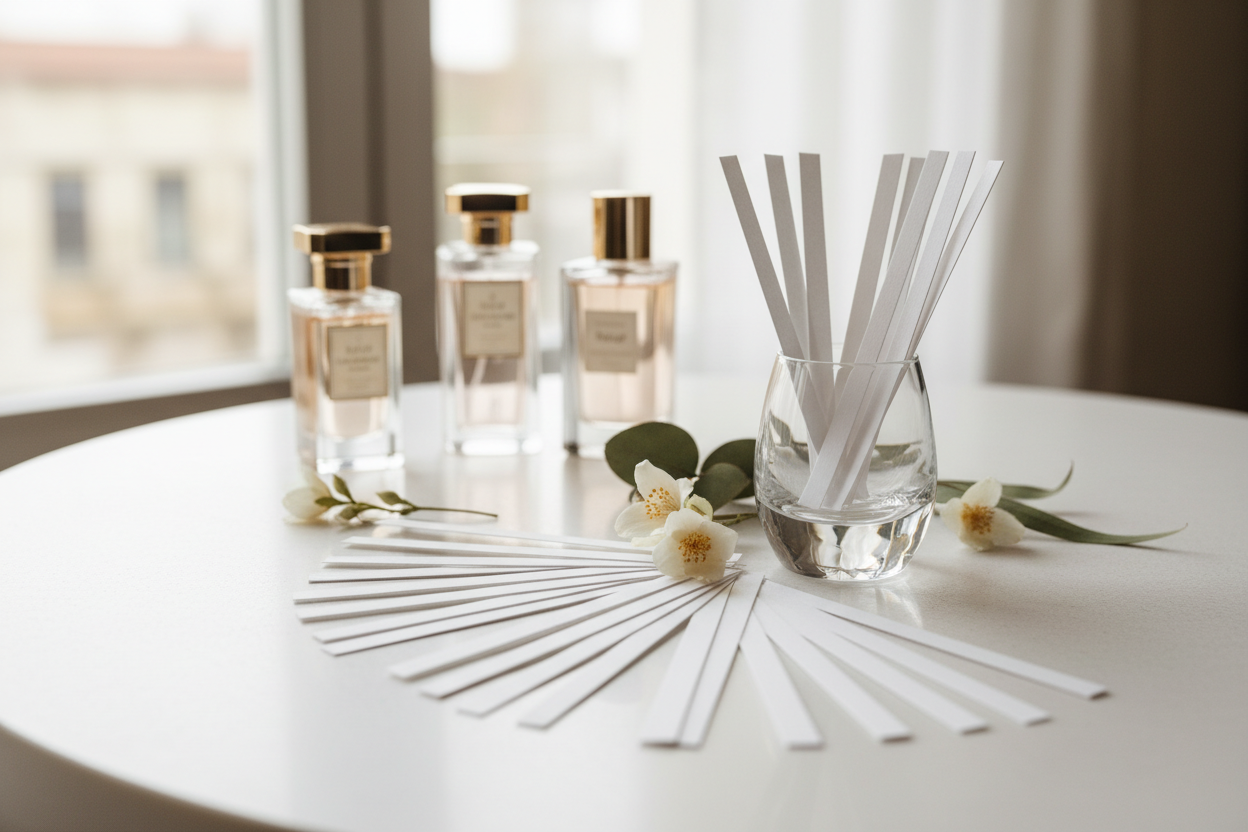
Fragrance strength, longevity and diffusion come down to volatility, the product base and the oil’s solvent load. How the three qualities work, how each base changes them, and how to test performance in the finished product.